

Glashütte, the town that went bust three times
I bought a NOMOS for the dial. Then I read the word printed under the brand name and found a town of seven thousand that went broke with silver, with the 1926 crisis and with the war, and was rebuilt twice by watchmakers.
I bought my Orion for the rosé dial, and only later noticed the small word under the brand name. Glashütte. I knew it was a German watch town, the vague way you know Le Brassus is Swiss. So I read up, and the town's story is better than the watch's: Glashütte went bust three times, and both times it got back up, watchmakers did it.
Before watches, glass and silver
The name means glassworks. There was one in the Müglitz valley in Saxony, destroyed in 1429 by the Hussites. Around 1490 silver was found and the place became a mining town. It never paid much: in some 250 years, about ten tonnes of silver and 150 of copper, and by the 1740s the mines were in decline.
In 1845 Glashütte was described as nearly worthless. The Saxon government was looking for an industry to give the valley work.
7 December 1845
The man who showed up was Ferdinand Adolph Lange, a Dresden watchmaker trained under Johann Christian Friedrich Gutkaes. He founded A. Lange & Cie on 7 December 1845 with a loan from the Royal Saxon government. Some sources put it at 7,800 thalers; Lange itself does not publish the figure.
He started with fifteen apprentices, local young men who wove straw, and brought the Swiss model of division of labour, one makes screws, another wheels, another barrels, and every apprentice who qualified could open his own workshop supplying the house. He brought the metric system into watchmaking in 1845 and, in 1851, tools that measured to a hundredth of a millimetre. He was mayor of Glashütte for eighteen years.
By the early 1860s there were eighty watchmakers making about eight hundred watches a year. Former apprentices opened their own houses: Julius Assmann in 1852, Moritz Grossmann, Strasser & Rohde. On 1 May 1878 the German School of Watchmaking opened with 23 students in two rooms, under Grossmann; three years later it had its own building for sixty to eighty. In 1920 teacher Alfred Helwig and his students built the first flying tourbillon there.
What became the Glashütte way
This is when the town got the look it still has. Instead of several bridges holding the wheels, a single plate covering three quarters of the movement, the three-quarter plate, which appears in Lange watches from 1864. Heat-blued screws and hands, gold chatons holding the jewels, the swan-neck regulator, the hand-engraved balance cock, the stripes known as Glashütte ribbing. Much of this existed elsewhere; what the school did was teach how to make it this way, part by part, in town.
1926, 1945, 1951
In 1926, with the crisis, 85% of the population was out of work. In 1927 a flood of the Müglitz killed at least 150 people. Two large factories were set up to create jobs, UROFA and UFAG, which would give rise to Tutima. In 1933 Union closed.
During the war the town made marine chronometers and 55 mm observation watches for aviation, the B-Uhren, using up to three thousand prisoners on twelve-hour shifts. On 8 May 1945, hours before the German surrender, a Soviet bombing raid destroyed the Lange and Tutima factories. In August the remaining machines left as war reparations: 32 ten-tonne trucks.
In 1948 everything was nationalized, and in 1951 seven companies became one, GUB, Glashütter Uhrenbetriebe. The Lange name left the dials. GUB made good watches, Glashütte Original itself calls the 1964 Spezimatic the most successful watch ever produced in the town, and it reached the end of East Germany with about three thousand employees.
1990, the second rescue
The Wall fell on 9 November 1989. In January 1990, two months later, Roland Schwertner registered NOMOS in Glashütte. The first watches came out in 1991 and 1992, designed by Susanne Günther: Tangente, Orion, Ludwig and Tetra, on a Peseux 7001 base.
On 16 October 1990 GUB was privatized and fell from about three thousand to 72 employees; in 1994 it became Glashütte Original, which Swatch would buy in 2000.
And on 7 December 1990, 145 years to the day after the founding, Walter Lange, Ferdinand Adolph's great-grandson, who had fled East Germany in 1948, registered A. Lange & Söhne again, with Günter Blümlein. The first four watches of the new Lange were shown on 24 October 1994 in Dresden. His words about that start: “when we started in 1989, I had no other goal than to revive the great tradition of A. Lange & Söhne in Glashütte”.
Then came the rest. Mühle reopened on 1 April 1994 with two employees. Union returned in 1996, Tutima in 2008, and that same year Christine Hutter refounded Moritz Grossmann and the German Watch Museum opened in the old school building. Lang & Heyne in 2001, Wempe in the old observatory in 2005.
Today, seven thousand people and ten brands
Glashütte has about seven thousand inhabitants and nine or ten brands, depending on how you count: A. Lange & Söhne, Glashütte Original, NOMOS, Mühle, Union, Tutima, Moritz Grossmann, Lang & Heyne, Wempe and Bruno Söhnle.
They do not all make watches the same way, which I did not know. Lange, Glashütte Original, NOMOS, Moritz Grossmann, Lang & Heyne and Wempe make their own movements in town; Glashütte Original even makes the hairspring. Mühle starts from a Swiss base, Sellita or ETA, and modifies it the local way, with a three-quarter plate, its own rotor and the “woodpecker” regulator it patented in 2003. Union and Tutima mix in-house calibres and Swiss bases. Bruno Söhnle uses Swiss movements and says so plainly.
The name is protected. A 1930 rule already required watches to be made at least essentially in the town, and on 22 February 2022 it became federal law: to carry Glashütte on the dial, more than 50% of the value of the essential steps must be created there, and assembly, regulation, dial, hands and casing must be done in town. Swiss Made asks for 60%, but of the whole of Switzerland, not one town.
NOMOS, first of the second rescue
NOMOS has its headquarters in the old railway station, production at Am Erbenhang and in Schlottwitz, and a design studio in Berlin. In 2005 it launched Alpha, its first in-house calibre; in 2014, the swing system, an in-house escapement, something very few independent brands make. Since 2016 the movements come from DUW, Deutsche Uhrenwerke, and the brand says up to 95% of the value of each watch is made in Glashütte.
A warning that applies to mine and to the Junghans I wrote about in August: NOMOS is often sold as a Bauhaus watch. The brand is a member of the Deutscher Werkbund, founded in 1907, and says the Orion comes from the tradition of the Glashütte school, with dials that recall the work of the watchmaking school's students. I do not call it Bauhaus.
Mine
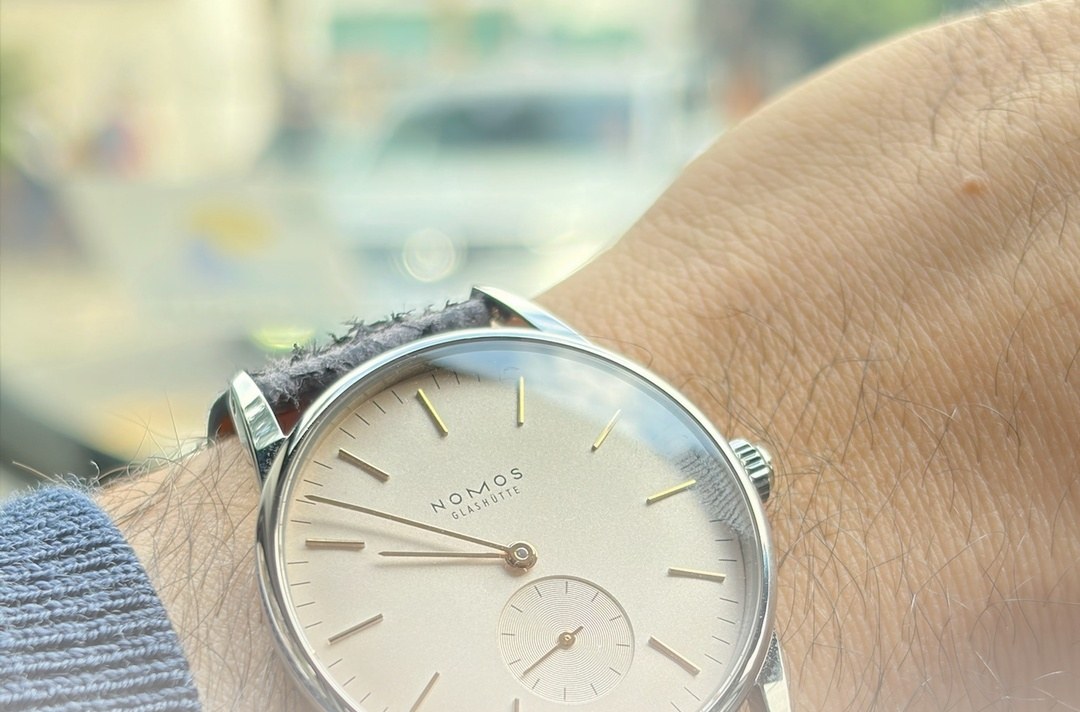
The Orion was one of NOMOS's first four designs, in 1992. Mine is the rosé: 35 mm, hand-wound, gold hands and indices, sapphire caseback. I bought it from an authorized dealer in Japan through Chrono24, and it went straight into my most worn. 23 logged wears, 8.4% of the rotation, mostly at work.
I expected an occasion watch, for its size and delicacy. That is not what the log shows: it goes out on any Tuesday, with a shirt, and comes back without ceremony. Maybe because under that rosé dial what is working is a three-quarter plate with Glashütte ribbing.
A six-hundred-year-old town with a hundred and eighty years of watchmaking, which went bust three times and came back through the work of people who knew how to make watches. On my wrist it fits in 35 millimetres.
Enjoyed this? Follow me at @semeupulsofalasse.
NOMOS Glashütte Orion rosé, ref. OR1A3GR2. From my own Horalog log, October 2026.
- Time+Tide — The history of Glashütte watchmaking (vidro, prata, 1845, o empréstimo, 1926, a guerra)
- WatchTime — Walking Through Glashütte, partes I a III (1926–1927, 1945, o resgate depois de 1990, as marcas de hoje)
- Glashütte Original — 180 anos de relojoaria em Glashütte (sistema métrico, a escola, o turbilhão voador, GUB, Spezimatic, privatização)
- NOMOS Glashütte — Glashütte watches e Watchmaking tradition (a estação, DUW, swing system, regra de Glashütte, prisioneiros na guerra)
- A. Lange & Söhne — A unique opportunity (Walter Lange, 7/12/1990, os quatro relógios de 1994)
- Wikipedia — A. Lange & Söhne; Glashütte Original; Nomos Glashütte; Mühle Glashütte
- Zoll.de — Glashütte-Verordnung, lei federal de 22/02/2022
- WatchPro — Nine Glashütte-based watch brands you need to know (quem faz movimento próprio)
- Jura Watches — NOMOS Orion rosé (o mostrador inspirado nos alunos da Uhrmacherschule)
This comes out of a real log.
Horalog is the logbook that produced every number in these articles. Open access during the beta, free.