

The Junghans max bill is not a Bauhaus watch
The school closed 28 years before the watch existed. The real story involves a factory that was once the world's largest, an anti-Nazi resistance, and an argument about what design should be.
Search for “Bauhaus watch” and the Junghans max bill comes up on the first line, anywhere in the world. Junghans itself leans into it: in 2019 it released editions marking the school's centenary.
The Bauhaus was founded in 1919, in Weimar, by Walter Gropius. It moved to Dessau in 1925, to Berlin in 1932, and closed in 1933 under pressure from the Nazi regime. The first max bill wristwatch is from 1961.
That is 28 years apart.
Where the watch actually comes from runs through a factory in the Black Forest, two siblings executed in Munich, and an argument about what design should be. These things rarely appear together.
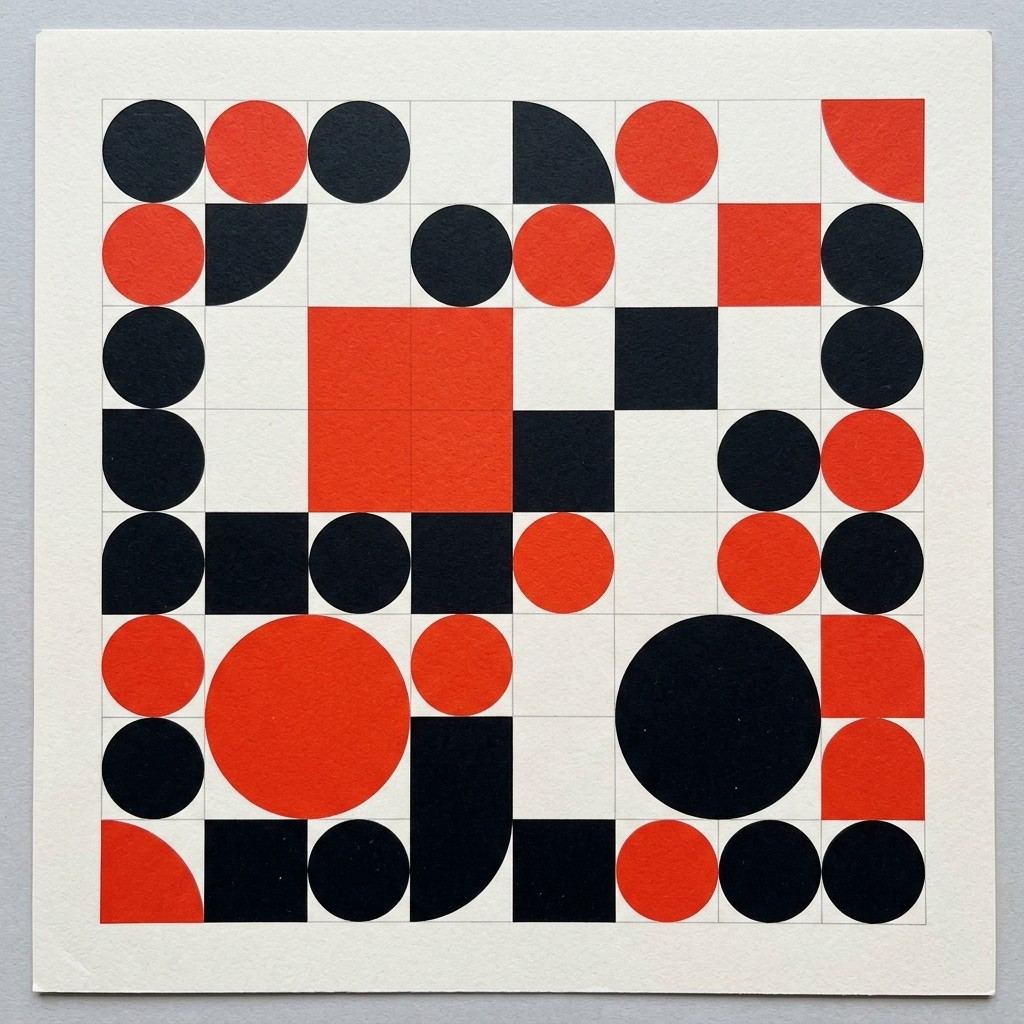
Schramberg, 1861
Erhard Junghans sets the company up on 15 April of that year, with his brother-in-law Jakob Zeller-Tobler. In its first years the factory did not make clocks. It made the parts for those who did. The first clocks carrying the Junghans name appear in 1866, and shortly after, with the founder's death, his widow Luise takes over.
The brand's eight-pointed star represents a gear wheel. It is still there.
By 1903 Junghans was the largest clock and watch factory on earth, with more than three thousand workers in Schramberg and more than three million pieces a year. By the 1960s it reached five million a year with roughly six thousand employees. Bill was not designing for a small brand.
It also kept inventing. In 1990 it launched the Mega 1, the world's first radio-controlled analogue wristwatch, designed by Hartmut Esslinger and Frog Design. A watch that set itself, fifteen years before that became ordinary.
The Bauhaus lasted fourteen years
Fourteen years and three addresses. Gropius founded the school on an idea that now sounds obvious: end the separation between art and craft, between the artist and the worker. Workshop instead of studio.
When it closes, in 1933, the faculty scatters. Gropius and Mies van der Rohe go to the United States, Josef Albers goes to Black Mountain College.
Max Bill had studied there for two years, in Dessau, under Albers, Wassily Kandinsky, Paul Klee, László Moholy-Nagy and Oskar Schlemmer. Swiss, born in 1908. He absorbed the method at the source, from the people who formulated it.
Where it actually comes from
In February 1943, Hans and Sophie Scholl were executed by the Nazi regime. They were students in Munich and belonged to the White Rose, a group that distributed leaflets against the war and against the regime. Arrested, tried and killed within days.
Their sister, Inge, survived. After the war she created the Scholl Siblings Foundation in their memory, and it is out of that foundation that the HfG Ulm is born, the School of Design.
Planning starts in 1949, with Otl Aicher, who would become Inge's husband, and the writer Hans Werner Richter. The money came from several hands: John McCloy, the American High Commissioner for Germany, a Norwegian European aid programme, and West German public funds. Classes begin in 1953.
A design school funded with American money, in memory of two young people killed by the regime, in a country that had just lost the war they tried to stop.
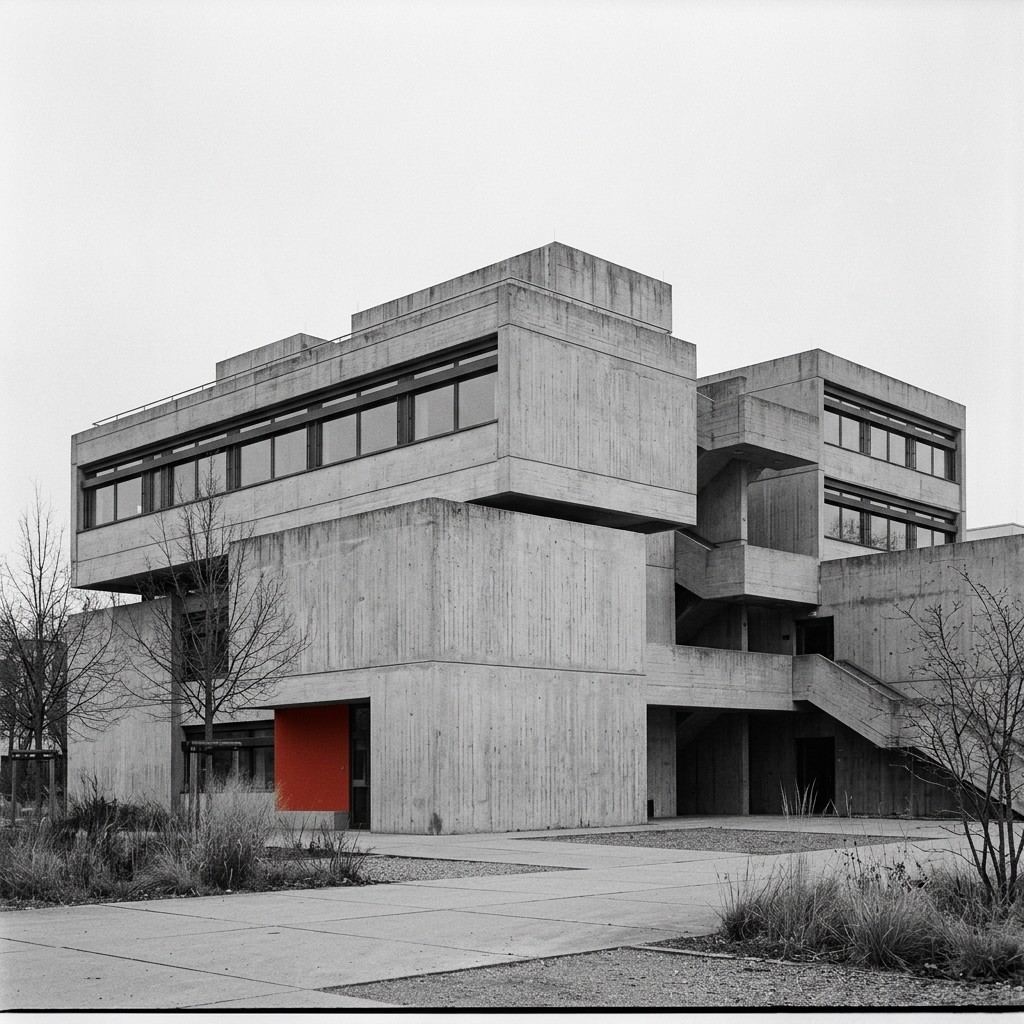
Max Bill was its first rector, from 1953 to 1957, and designed the campus on the Oberer Kuhberg. It was he who publicly positioned the HfG as a continuation of the Bauhaus, which helps explain why the labels are still confused. The school had departments of Industrial Design, Visual Communication, Building, Information and Film.
The argument Bill lost
He left in 1957 after losing a fundamental disagreement. Bill argued for design as a continuation of the Bauhaus: the designer as artist, form as expression. The school's younger generation, with Otl Aicher, Tomás Maldonado and Hans Gugelot, wanted design as a scientific discipline, with method, ergonomics, semiotics and systems theory.
The second position won. Ulm is where the idea of a design process comes from, of user research, of systems: the vocabulary now used without anyone wondering where it came from.
The school lasted fifteen years. In November 1968 the parliament of Baden-Württemberg cut its funding, citing internal conflict and cost, and it closed at the end of that year despite student protests.
What came out of Ulm in fifteen years
Hans Gugelot, an HfG teacher, designed the Braun SK4 with Dieter Rams in 1956, the radio-phonograph with the transparent lid that became known as “Snow White's coffin”. It is the object that founds Braun's language, and with it much of the language of the electronic products that followed.
Otl Aicher signed the visual identity for the 1972 Munich Olympics, including the pictograms: the little sport figures now in airports and on street signs worldwide. He also created the Rotis typeface.
A school that closed for lack of money in 1968 defined how you read an airport.
The watch
Bill's first work for Junghans was a kitchen clock with a timer, from 1956, made together with students at Ulm. It sold in the thousands, became furniture in German homes, and is now in MoMA's collection. Wall clocks came at the end of the decade.
The wristwatch was last in line, in 1961, in three dial versions. The design is practically unchanged today, sixty-five years later.
Notice what it does not have. No bezel, no frame around the dial, no date, no seal. Numerals, hands and the minimum of marking. To anyone coming from sports watches something seems to be missing, and that is the Ulm doctrine applied literally: nothing that does not serve reading the time.
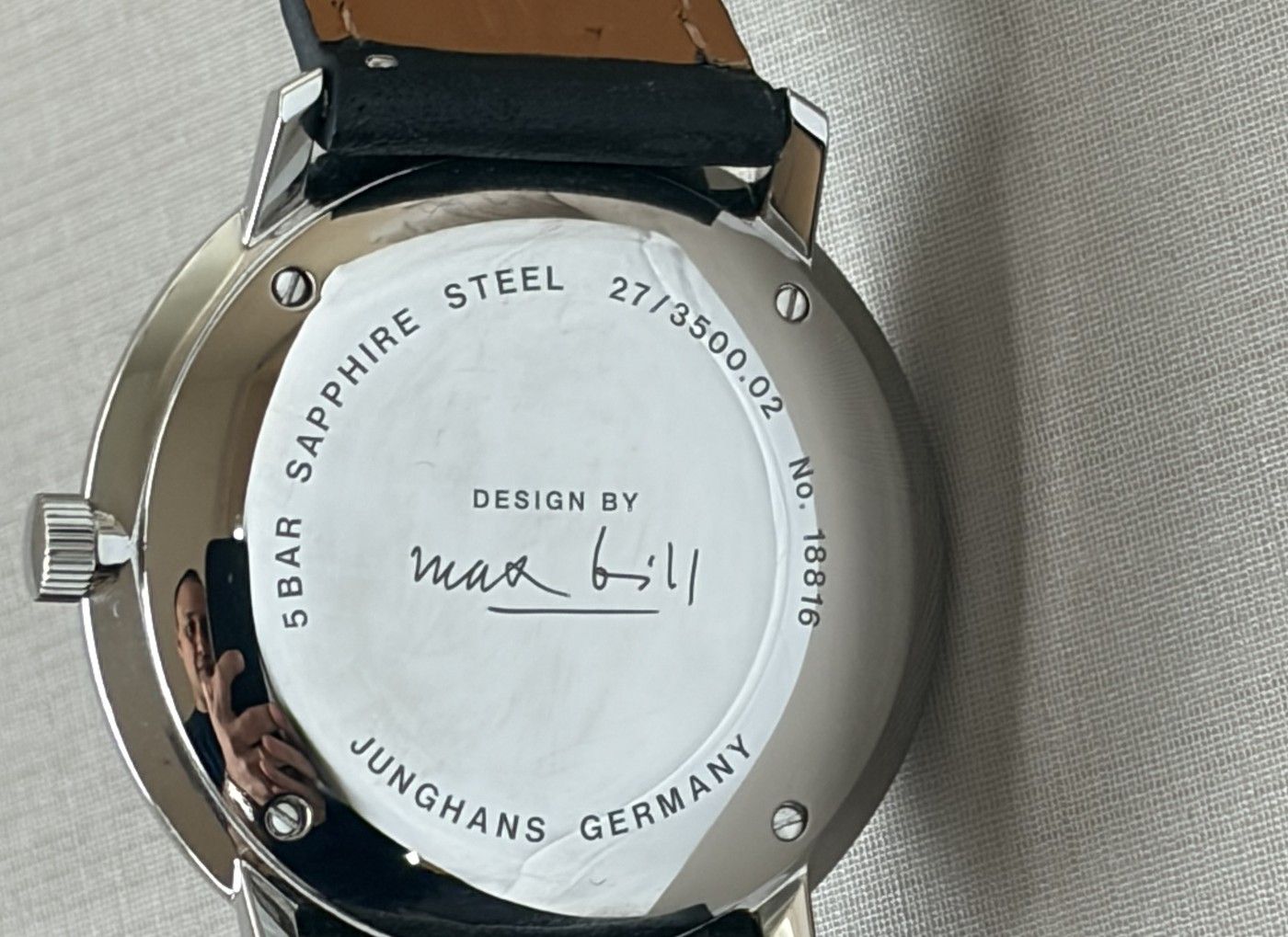
Max Bill's signature is engraved on the caseback, next to the reference and the serial number, where only the wearer sees it. The dial carries no authorship at all.
2008
Industrial Junghans goes bankrupt, under the control of a Hong Kong group, and is bought by a businessman from Schramberg itself with eighty-five employees. In 1903 there were more than three thousand.
What survived as the brand's main asset was the design a Swiss artist made in 1961.
Calling it Bauhaus is not quite wrong. The DNA is the same and the person who carried that DNA was a student of the house. But the address is different, and the address has the better story: a foundation created in memory of two murdered siblings, an argument about what design should be, and a giant factory that now survives selling the object one of its designers drew. It took me eight months of logging to find out I wear it more than I thought.
Enjoyed this? Like the post (in Portuguese) and follow me at @semeupulsofalasse.
Junghans max bill Automatic, ref. 27/3500.02. From my own Horalog log, August 2026.
This comes out of a real log.
Horalog is the logbook that produced every number in these articles. Open access during the beta, free.