

Seiko AGS: the father of Kinetic, and the day I thought mine had died
Seiko caused the quartz crisis in 1969, then spent twenty years trying to fix the problem it had created: the battery.
In December 1969 Seiko launched the Astron, the first quartz wristwatch in the world. What followed became known as the quartz crisis: Swiss factories closing, watchmakers losing their jobs, and the mechanical watch turning into a museum piece for a good fifteen years.
Seiko had solved the accuracy problem and created another one in its place. Every quartz watch now depended on a battery.
That bothered more people inside Epson, the group's technical arm, than you would expect. The concern they put on record is unromantic enough to be convincing: in many parts of the world batteries were hard to come by, and there was the problem of disposing of used ones. From the beginning of quartz development they had been trying other ways to feed the circuit.
1983
That is the year development starts in earnest. The idea was old and the execution was the hard part: use the same rotor as an automatic watch, that weight which spins with the movement of the arm, but instead of winding a mainspring, turn a generator.
The generator charges a capacitor. The capacitor feeds the quartz circuit. Quartz accuracy, automatic autonomy, and no battery.
The watch reaches the market in January 1988, in Germany, and in April in Japan, under the name Seiko Auto-Quartz. The system was called AGS, for Automatic Generating System. In 1997 Seiko renamed everything Kinetic, and that is the name that stuck. Anyone saying Kinetic today is talking about AGS without knowing it.
The line meant for young buyers
In the mid-1990s Seiko realised it was losing the young buyer. The solution was peculiar: instead of hiring a consultancy, management asked two junior engineers on staff to design a line for their own age group.
Out came SUS, for Simple and Strong. Japanese market only. Small cases, around 35 mm, at a time when the world was already drifting towards big watches. The visual reference was old military watches: legibility above everything and no showing off.
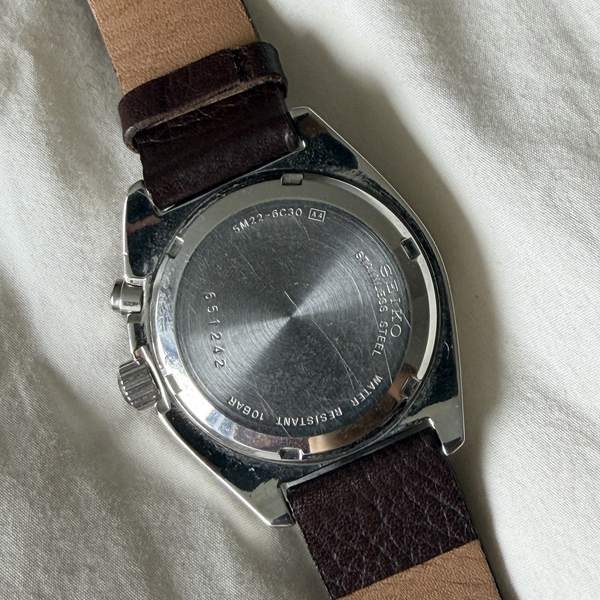
Mine is a SUS from May 1996, calibre 5M22, 37 mm, red dial.
The button that sets nothing
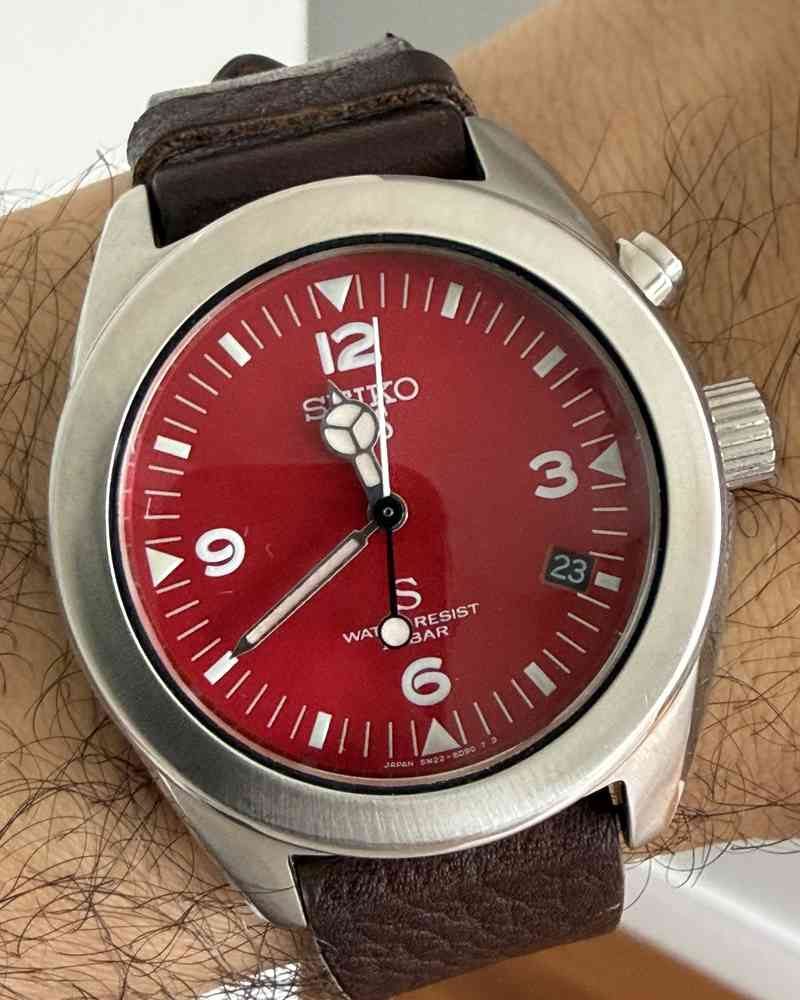
Above the crown there is a small button that adjusts neither time nor date. Press it and the seconds hand shoots forward, stops at a point and comes back. The distance it travelled is the energy left in the capacitor.
An analogue battery meter, in 1996, with no display, no number, nothing electronic showing. The information is given by the same hand that was already there.
The day I thought it had died
I was photographing the watch to build a post when I noticed the seconds hand was moving in two-second steps. It is not a fault. It is how the AGS warns that the reserve is running out: it saves power by moving the hand half as often.
My first guess was the capacitor. It is the component that ages in these movements, and mine is thirty years old. I was already working out what a replacement would cost.
I put it on to charge and it held firmly. The capacitor is healthy.
I checked my log and the answer was there, in one line: very few wears in the previous thirty days. A Kinetic draws energy from movement and nothing else, no winding, no battery, no charger. It is the only kind of watch that stops if you don't wear it.
It was not asking for a service.
Without the log I would have taken a healthy watch to a watchmaker, and probably come back with it repaired of something that was not broken. The data did not impress me with a pretty chart. It saved me from spending money on a wrong guess about my own collection.
Enjoyed this? Like the post (in Portuguese) and follow me at @semeupulsofalasse.
Seiko AGS SUS, ref. 5M22-6C30. From my own Horalog log, August 2026.
This comes out of a real log.
Horalog is the logbook that produced every number in these articles. Open access during the beta, free.